From Reuters:
China has launched a four-month "war" on tainted food, drugs and exports, state media reported on Friday, as beleaguered officials embraced time-tested campaign tactics to clean up the country's battered image.
Chinese Vice Premier Wu Yi told officials that the campaign, to run to the end of the year, would focus on problem products that have corroded domestic and foreign consumers' confidence in the "made in China" label.
"This is a special battle to protect the health and personal interests of the public and to protect the reputation of Chinese goods and the national image," Wu said, according to the government Web site (www.gov.cn).
She called the campaign a "stern political task" -- a reminder that officials' careers may be on the line.
Wu announced targets to clean up pig slaughtering, restaurants and canteens, pesticide use, food additives and the country's vital exports. "In some businesses the management level is low, production conditions are poor, quality levels and standards are low, and reliability is weak," she said.
Local officials may not share Wu's determination to move so fast, said the China Daily.
"Building an omnipresent monitoring and guarantee mechanism will prove a challenging mission for a four-month campaign," the paper said.
Saturday, August 25, 2007

Thursday, August 23, 2007
CRAMER'S MAD MONEY = CRAMER'S BAD ADVICE?
CNBC crazy man Jim Cramer who made millions in the 1980s and 1990s with his hedge fund rolls up his sleaves, beats his chest, and makes seemingly thousands of stock picks  per show on Mad Money, but Barron's reports that Cramer's picks overall do not beat the S&P 500.
From Barron's August 20th edition:
"Over the past two years, viewers holding Cramer's stocks would be up 12% while the Dow rose 22% and the S&P 500 16%, according to a record of 1,300 of the CNBC star's Buy recommendations compiled by YourMoneyWatch.com, a Website run by a retired stock analyst and loyal Cramer-watcher."
"We also looked at a database of Cramer's Mad Money picks maintained by his Website, TheStreet.com. It covers only the past six months, but includes an astounding 3,458 stocks - Buys mainly, punctuated by some Sells. These picks were flat to down in relation to the market. Count commissions and you would have been much better off in an index fund that simply tracks the market."
After an initial day-after 2% pop for Cramer's picks, the stocks "usually moved sideways or down for the following 30 trading days. This offered an opportunity to make money - 5% to 30% a year - by selling Cramer's selections short." Short selling is betting that a stock price will drop and profiting from that drop.
per show on Mad Money, but Barron's reports that Cramer's picks overall do not beat the S&P 500.From Barron's August 20th edition:
"Over the past two years, viewers holding Cramer's stocks would be up 12% while the Dow rose 22% and the S&P 500 16%, according to a record of 1,300 of the CNBC star's Buy recommendations compiled by YourMoneyWatch.com, a Website run by a retired stock analyst and loyal Cramer-watcher."
"We also looked at a database of Cramer's Mad Money picks maintained by his Website, TheStreet.com. It covers only the past six months, but includes an astounding 3,458 stocks - Buys mainly, punctuated by some Sells. These picks were flat to down in relation to the market. Count commissions and you would have been much better off in an index fund that simply tracks the market."
After an initial day-after 2% pop for Cramer's picks, the stocks "usually moved sideways or down for the following 30 trading days. This offered an opportunity to make money - 5% to 30% a year - by selling Cramer's selections short." Short selling is betting that a stock price will drop and profiting from that drop.
Wednesday, August 22, 2007
WAL-MART PET FOOD FROM CHINA FOUND TO HAVE MELAMINE
From USA Today:
Tests of two Chinese brands of dog treats sold at Wal-Mart stores found traces of melamine, a chemical agent that led to a previous, large-scale pet food recall in March, a spokeswoman said Tuesday.
Wal-Mart Stores stopped selling Chicken Jerky Strips from Import-Pingyang Pet Product and Chicken Jerky from Shanghai Bestro Trading in July, after customers said the products sickened their pets.
No recall was announced at that time, but Wal-Mart said in a statement Tuesday that customers who bought one of the products should return it to the nearest store for a refund.
Company spokeswoman Deisha Galberth said 17 sets of tests done on the products found melamine, a contaminant that's a byproduct of several pesticides.
The Delaware County (Pa.) Daily Times reported last week that a woman claimed her 2-year-old Chihuahua died after eating some of the products.
Tuesday, August 21, 2007
NIKE WINS PITTANCE IN CHINESE COUNTERFEIT LAWSUIT
Think this is an isolated case of counterfeiting? Google "counterfeit Nike" and check out the results, or check out this link to an official Chinese customs site that details efforts to catch counterfeiters. The picture below is of 55,000 counterfeit goods confiscated in Tianjin, China.

From USA Today:
Nike has won lawsuits against two Chinese shoemakers and the local operations of a French supermarket chain over alleged illegal copying of its Air Jordan logo, a court official said Tuesday.
The Shanghai No. 2 Intermediate Court awarded Nike, the world's largest sports apparel company, a total of 350,000 yuan ($46,100) in damages from Jinjiang Longzhibu Shoe Co., Jinjiang Kangwei Shoe Co. and retailer Auchan, the official Xinhua News Agency and other reports said.
The case was the latest victory for foreign companies seeking protection from rampant theft of copyrights and other intellectual property in China. Regardless of laws against commercial piracy, counterfeit copies of most products can be easily found in Chinese stores and markets.
Nike said its employees found shoes made by the companies being sold for about 100 yuan ($13) a pair in outlets operated by the Auchan chain in Shanghai and the nearby city of Ningbo. Authentic Air Jordans sell for many times that amount.
Monday, August 20, 2007
JOB TIPS FOR RECENT GRADUATES
Please click the link to read the entire article.
From the Chicago Sun-Times:
From the Chicago Sun-Times:
- Don't be afraid to ask for help.
- Dress like a professional, not someone who just got out of college.
- Work on your written and spoken communication skills. No professional e-mail to a colleague or customer should start out with, "hey, dave ..." And capitalization is a beautiful thing.
- Be prepared for criticism.
- Respect deadlines.
CHINESE STATE TV DEFENDS CHINESE-MADE PRODUCTS
From USA Today:
Chinese state television has launched a week-long series of programs dedicated to defending the country's reputation as a safe maker of global goods, pushing forward its campaign to woo back international trust.
The first program was aired Sunday on China Central Television's economic channel and featured the head of a quality watchdog criticizing the recent furor over the quality of Chinese exports as "demonizing China's products."
"Personally, I believe it is new trend in trade protectionism. Although recalls are necessary, it is unfair to decide that all products made in China are unqualified," Li Changjiang, director of the General Administration of Quality Supervision, Inspection and Quarantine, said on the inaugural 90-minute show, titled "Believe in Made in China."
The programs are the latest in China's recent push to prove it is a safe manufacturer and exporter of goods amid discoveries of high levels of chemicals and toxins in Chinese products by countries around the world, from toothpaste to fish.
On Monday, New Zealand launched an investigation after children's clothes from China were found to contain dangerous levels of formaldehyde.
The government ordered the probe after scientists testing clothes for TV3's "Target" consumer watchdog program discovered formaldehyde concentrations up to 900 times above the safe level in woolen and cotton clothes.
The chemical gives a permanent press effect to clothes and is also used as an embalming fluid. It can cause problems ranging from skin rashes to cancer.
The television station says it will not release details of brand names or importers ahead of the show's airing on Tuesday.
Saturday, August 18, 2007
WEAK DOLLAR VERSUS EURO CAUSES DECLINE IN GERMAN CAR SALES
Remember, a weak dollar causes imported foreign goods to be more expensive for those using the dollar to make purchases, while U.S.-made goods exported to other countries, in this case Germany, a user of the Euro, are less expensive to those using the Euro.
From The New York Times:
This year, the dollar was down about 6 percent against the euro, which damaged German car sales in this country. Its auto trade surplus with the United States fell 30 percent.
The declining American trade deficit for the auto industry does not mean that this country is anywhere close to reaching a balance in the sector. During the second quarter, the United States imported $1.90 in automobiles and parts for every dollar of such goods it exported. That is the lowest ratio since 1998 and is down from $2.27 in the 2006 period. It is way below the record ratio of $4.22, reached in 1989.
But it still means that it would take a 31 percent increase in American auto exports, and a similar decrease in imports, to produce a balance in auto trade. That would require a much lower dollar — and a much weaker American economy.
Friday, August 17, 2007
FED LOWERS KEY DISCOUNT RATE HALF POINT
From USA Today:
Stocks soared Friday after the Federal Reserve did what Wall Street was clamoring for and cut its key discount rate a half percentage point.
The move quelled investors' credit worries at least for the time being and initially sent the Dow Jones industrials up more than 300 points before retreating some.
The Fed — which had resisted lowering rates despite weeks of market volatility, and instead added nearly $120 billion in liquidity into the banking system — cut its discount rate to 5.75% from 6.25%. The Fed acknowledged that the stock market turbulence that has pulled the Dow by hundreds of points a day was posing a risk to economic growth.
But the central bank made no mention of lowering its target for the federal funds rate, which has stood at 5.25% for more than a year. The fed funds rate determines the rates that banks charge each other for loans, while the discount rate only covers loans the Fed makes to banks. Many strategists believe the market won't settle down until the Fed lowers the fed funds rate target, considered a more significant benchmark.
Traders who bet on how the Fed might alter rates now expect the central bank will lower the benchmark fed funds rate at its next meeting on Sept. 18. Some investors are hoping for a cut in that benchmark rate even sooner.
"If the cut in the discount rate succeeds in restoring confidence, then perhaps there is no need for the Fed to cut rates at the Sept. 18 meeting," said John Lonski, chief economist of Moody's Investor Service. He added, though, that the key line in the Fed's statement Friday was its willingness to take more steps to prevent market volatility from harming the economy.
"That means the Fed is prepared to make a rate cut if stability doesn't come," Lonski said.
Thursday, August 16, 2007
FAKE DIABETES TEST STRIPS TRACED TO CHINA
From the International Herald Tribune:
A global manhunt begun by Johnson & Johnson has traced to China counterfeit versions of an at-home diabetes test used by 10 million Americans to take sensitive measurements of blood sugar levels.
Potentially dangerous copies of the OneTouch Test Strip sold by Johnson & Johnson's LifeScan unit surfaced in U.S. and Canadian pharmacies last year, according to federal court documents unsealed in June but only recently discovered by Bloomberg News.
Court filings disclose, for the first time, that China is the source of about one million phony test strips, which have turned up in at least 35 states and in Canada, Greece, India, Pakistan, the Philippines, Saudi Arabia and Turkey.
Fake medicines are a $32 billion global business, said the World Health Organization, and the Food and Drug agency said it had run 54 counterfeit investigations in 2006, almost twice as many as in the year before.
Records seized from the importers show the counterfeit strips were bought from Henry Fu and his company, Halson Pharmaceutical, which, according to its Internet site, is based in Shanghai.
Halson's Web site says that the company distributes and manufactures medical supplies like syringes, and is run by Fu, who, according to a court order, is also known as Su Zhi Yong. Fu was arrested by the Chinese authorities and remains in prison in China, awaiting resolution of his case in the People's Court of Shanghai.
Wednesday, August 15, 2007
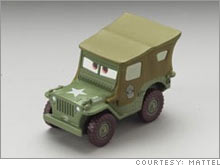
MATTEL CHINESE-MADE TOY RECALL UP TO NEARLY 19 MILLION
 From CNN Money:
Mattel Inc. Tuesday recalled more than 9 million toys made in China and sold in the United States, including "Polly Pocket" and "Batman" dolls and other popular figures, because of loose magnets and lead paint - its second major recall in less than a month.
The recall affects 9.58 million imported toys sold at toy stores, discount stores and other retailers nationwide dating back as far back as May 2003. Worldwide, Mattel said the recall includes nearly 19 million toys. The company said the recalls would cost about $30 million.
The recall is the latest development in the growing crisis over the safety of Chinese products. Chinese officials have gone out of their way to stress the safety and quality of its exports, blaming the problems on a small number of companies. Earlier this month, China's Commerce ministry blacklisted 400 export firms following the recent product safety scares.
Saturday, August 11, 2007
MOTOROLA PINS HOPES ON NEW RAZR
 From Howard Wolinsky of the Chicago Sun-Times:
Motorola said Friday the next generation of its hugely popular RAZR thin clamshell phone -- one of the Schaumburg company's great hopes to spark a turnaround -- will be available from all major mobile phone carriers within 60 days.
RAZR2 will be available starting in the next two weeks. Tracey Thiele, Motorola spokeswoman, said that by October, the new RAZR2 will be sold by AT&T, Sprint, T-Mobile and Verizon, the top national carriers, and Alltel and Chicago-based U.S. Cellular, the regional carriers.
RAZR2 is part of a new product lineup, which Motorola hopes can turn around the company. Motorola, which invented the cell phone in 1973, has suffered a series of setbacks, dropping in the last quarter to No. 3 in the industry.
MILK PRICES SOARING
From USA Today:
It's cheaper than oil and, barring a global mad cow crisis, we'll probably never run out of it. But milk has one thing in common with oil: It's trading at record highs.
Milk prices hit a record last month in the United States, where consumers paid an average $3.80 a gallon, compared to $3.29 in January, according to the U.S. Department of Agriculture. It forecasts prices will remain high throughout the year.
International dairy prices increased 46% between November 2006 and April 2007, with milk powder prices increasing even faster, according to the Food and Agriculture Organization.
The boom in biofuels is also pushing up corn prices and, as a result, making animal feed more expensive. Farmers have responded by raising milk prices. Corn futures indicate that the price of corn will remain high this year, according to the Washington-based International Dairy Foods Association. Prices have also risen for soybeans, another feed crop, it said.
Friday, August 10, 2007
FEDERAL RESERVE PUSHES $38 BILLION INTO CIRCULATION
From Reuters:
The U.S. Federal Reserve provided the banking system with $38 billion on Friday, the largest amount of liquidity since the days after the September 11 attacks six years ago, adding ample funds for the second day running as financial markets fretted over credit conditions.
In its statement after Friday's first market operation, the Fed said it would provide liquidity as needed "to facilitate the orderly functioning of financial markets.
"In current circumstances, depository institutions may experience unusual funding needs because of dislocations in money and credit markets," it said.
The last time the central bank made a similar statement was after the September 11, 2001, terror attacks, when it also said it would do what was necessary to keep markets functioning normally. The Fed made a similar vow in October 1987 following a precipitous decline in U.S. stock markets.
Central banks worldwide have now injected at least $326.3 billion in the past 48 hours to prevent markets from spinning into a global liquidity squeeze. Short-term interest rates spiked in response to banks' decreased willingness to lend to each other.
Friday, April 27, 2007
U.S. GDP GROWTH SLOWS TO 1.3%
Many economists had predicted that first-quarter GDP growth would be 1.8%, but the data released this morning showed even slower growth coming in at 1.3%. That is the worst quarterly performance since Q1 2003.
From USA Today:
The fresh reading on gross domestic product, released by the Commerce Department on Friday, was even weaker than the 2.5% annual growth rate logged in the final three months of last year. The new figures underscored just how much momentum the economy has been losing as it copes with the strain of the troubled housing market, which has made some businesses more cautious in their spending.
A price gauge favored by the Federal Reserve — personal consumption expenditures excluding food and energy items — increased at a 2.2% annual rate in the first quarter, slightly ahead of forecasts for a 2.1% advance. That was up substantially from the fourth quarter's 1.8% annual rate and is likely to keep Fed policymakers wary about the potential for a pickup in inflation.
Thursday, April 26, 2007
WENDY'S FOR SALE?
 Wendy's has been in a slump for quite some time and the board is considering selling the company to the highest bidder.
From WSJ.com:
The Dublin, Ohio, company said yesterday that its board formed a special committee of independent directors to investigate all strategic options for Wendy's. The company said the committee is weighing a possible sale, merger or other "business combination," and contemplating changing Wendy's strategic plan and capital structure. Chairman James V. Pickett will lead the committee. There has been previous speculation that Wendy's could be sold.
The Wendy's board review could make it more difficult for Chief Executive Kerrii Anderson to rally investors around the turnaround plan she has been pushing for the past year. Ms. Anderson has made numerous presentations to Wall Street touting Wendy's new strategy of stronger marketing, more new products, sharper store operations and better relationships with the franchisees who own Wendy's outlets. Her changes have helped lift Wendy's same-store sales, a key measure of the company's performance.
But Wall Street is concerned that her growth targets may be overly optimistic, and that the plan relies on succeeding in areas where Wendy's has failed before. For instance, executives have pinned some of Wendy's projected sales growth on a new breakfast menu that Wendy's wants to have in more than half of its North American locations by next year. Wendy's tried a breakfast menu in the 1980s and it flopped.
Wendy's said its first-quarter net income fell 71% to $14.7 million. Revenue rose 2%.
LASALLE BANK SALE TO BANK OF AMERICA STILL ON TRACK?
Dutch parent ABN entered into an agreement to sell Chicago-based LaSalle Bank to Bank of America Sunday (some reports list Monday), but that deal may be in jeopardy now that Royal Bank of Scotland has formed a consortium that offered $98.58 billion for all ABN banking assets, which is considerably higher than the $88.35 billion offered by Barclays. In an unusually restrictive contract clause ABN's sale of LaSalle to Bank of America will become permanent on May 7 and cannot be reversed, making consideration of the RBS offer an urgent matter.
From SunTimes.com:
The uncertainty centers on whether ABN Amro's surprise move Monday to sell LaSalle Bank Corp. to Bank of America Corp. for $21 billion, as part of its deal with Barclays, can be undone.
ABN Amro said Wednesday other banks have 14 days to submit superior bids for LaSalle. If any does, Bank of America then has five days to match that bid; if it fails to do so, it will receive a $200 million breakup fee.
WSJ.com
Wednesday, April 25, 2007
TOYOTA #1 IN GLOBAL VEHICLE SALES IN 1ST QUARTER
 There is a new leader in global car sales according to data from 2007 first quarter sales.
From The Washington Post:
General Motors' 76-year reign as the world's largest automaker is over.
Fifty years after its cars first hit U.S. shores, Japanese automaker Toyota has surged past the 20th-century American colossus, selling more vehicles worldwide than GM during the first three months of this year.
The global sales benchmark had been looming for years, and its realization was only a matter of time, analysts said. In the United States, GM still sells the most vehicles, owning about 23 percent of the market, compared with Toyota's 16 percent.
GM had managed to hold on to its shrinking lead over Toyota in recent years, but the two companies are heading in opposite directions. GM has lost $12.4 billion over the past two years and plans to close 12 North American plants by the end of next year. By comparison, Toyota reported a profit of about $12 billion during its most recent fiscal year and expects to open its eighth North American factory in 2010.
For the first three months of 2007, Toyota sold 2.35 million vehicles worldwide, compared with 2.26 million for GM. Notably, Toyota's sales were up 9.2 percent over the first three months of 2006, while GM's were up 3 percent.
Last year, GM sold 9.1 million vehicles to Toyota's 8.8 million.
Toyota expects to sell 9.3 million cars in 2007; GM does not provide forecasts.
Saturday, April 21, 2007
VIOXX CASES ON HOLD IN TEXAS DUE TO NEW RULING
Merck, the manufacturer of Vioxx, is the beneficiary, if only temporarily, of a judge's ruling that the 1,000 personal injury lawsuits in Texas must be delayed or possibly even thrown out because of 2003 tort reform law in that state.
From the AP at Yahoo:
From the AP at Yahoo:
State District Judge Randy Wilson, based in Harris County, granted a motion by Merck & Co. Inc., the drug's manufacturer, to dismiss part of a lawsuit filed by Ruby Ledbetter.
Merck's attorneys argued a 2003 Texas law prevents Ledbetter from claiming she wasn't properly warned about Vioxx.
The law, passed as part of tort reform efforts, says a drug manufacturer is not liable in allegations it failed to provide sufficient warnings about its product if the drug in question came with warnings approved by the Food and Drug Administration.
The law, passed as part of tort reform efforts, says a drug manufacturer is not liable in allegations it failed to provide sufficient warnings about its product if the drug in question came with warnings approved by the Food and Drug Administration.
Friday's ruling put Ledbetter's case, which was set to go to trial in May, on hold.
But Travis Sales, one of Merck's attorneys, and Tommy Fibich, one of Ledbetter's attorneys, both said Wilson had previously told lawyers in the case that such a decision would put all Texas cases on hold until appeals courts rule on the issue.
Wilson, who is presiding over all Vioxx lawsuits filed in Texas, said in his ruling that virtually all the Texas cases allege that Merck failed to provide an adequate warning.Friday, April 20, 2007
CHINESE ECONOMY CONTINUES GROWING AT BRISK PACE
 GDP data released by the Chinese National Bureau of Statistics Thursday shows that the Chinese economy continues to grow at an amazing pace, up 11.1% for the first quarter of 2007 compared to the same time-frame for 2006.
From The New York Times:
The surge in growth is almost certain to force Beijing to step up efforts to cool the economy. Pressure is also mounting on officials to allow the value of the currency, the yuan, to appreciate more quickly.
Fueled by soaring exports and huge investments in infrastructure, factories and energy supplies, China could soon overtake Germany to become the world’s third-largest economy, behind those of the United States and Japan.
The burst of growth, one of the largest in a decade, came on the heels of four consecutive years of double-digit economic growth, including an increase last year of 10.7%, the fastest annual growth in a decade.
The statistics bureau said that retail sales rose 15%, industrial production was up 18% and exports jumped 28%.
CRIME DOES NOT PAY FOR QWEST'S NACCHIO
 Former Qwest CEO Joe Nacchio was convicted yesterday on 19 insider trading counts of the 42 with which he had initially been prosecuted. Each charge carries with it a maximum of 10 years in prison and $1 million fine.
From BusinessWeek:
In the latest in a series of convictions against corporate executives, one-time CEO Joe Nacchio was found guilty of illegally selling $52 million in stock amid an accounting scandal that nearly sank Qwest Communications.
Nacchio left the federal courthouse with his wife and son Michael after Thursday's verdict, declining to comment yet determined to appeal the 19 insider trading convictions, each of which carries a sentence of up to 10 years in prison and a $1 million fine.
Nacchio is one of a handful of former Qwest executives who have been convicted of criminal charges stemming from a multibillion-dollar scandal that forced the Denver-based telecommunications company to restate $2.2 billion of revenue.
He also is the latest to be convicted as part of the government's push to punish white-collar executives stemming from accounting fraud at companies from Enron to WorldCom.
"'Convicted felon Joe Nacchio' has a very nice ring to it," boasted Troy Eid, the U.S. attorney for Colorado.
The Justice Department has gone after a number of corporate executives in cases involving accounting and fraud scandals in the late 1990s and 2000 that sparked outrage among investors.
Former Cendant Corp. Chairman Walter Forbes is serving more than 12 years in prison and has been ordered to pay $3.28 billion in restitution. He was convicted of conspiracy to commit securities fraud and other charges in a massive fraud scheme that cost the travel and real estate company and its investors more than $3 billion.
Former WorldCom chief Bernard Ebbers is serving a 25-year prison sentence for his role in the fraud that drove that Clinton, Miss.-based company into bankruptcy in 2002.
Former Enron chief executive Jeffrey Skilling is serving 24 years and four months in prison for fraud and other crimes in the collapse of the former energy giant. Enron founder Ken Lay also was convicted, but a judge vacated that decision when Lay died of a heart attack last year.
HealthSouth Corp. founder Richard Scrushy was acquitted of all charges in a $2.7 billion fraud during his tenure at HealthSouth.
Subscribe to:
Posts (Atom)