Saturday, August 11, 2007

MOTOROLA PINS HOPES ON NEW RAZR

From Howard Wolinsky of the Chicago Sun-Times:

Motorola said Friday the next generation of its hugely popular RAZR thin clamshell phone -- one of the Schaumburg company's great hopes to spark a turnaround -- will be available from all major mobile phone carriers within 60 days.

RAZR2 will be available starting in the next two weeks. Tracey Thiele, Motorola spokeswoman, said that by October, the new RAZR2 will be sold by AT&T, Sprint, T-Mobile and Verizon, the top national carriers, and Alltel and Chicago-based U.S. Cellular, the regional carriers.

RAZR2 is part of a new product lineup, which Motorola hopes can turn around the company. Motorola, which invented the cell phone in 1973, has suffered a series of setbacks, dropping in the last quarter to No. 3 in the industry.

MILK PRICES SOARING

From USA Today:

It's cheaper than oil and, barring a global mad cow crisis, we'll probably never run out of it. But milk has one thing in common with oil: It's trading at record highs.

Milk prices hit a record last month in the United States, where consumers paid an average $3.80 a gallon, compared to $3.29 in January, according to the U.S. Department of Agriculture. It forecasts prices will remain high throughout the year.

International dairy prices increased 46% between November 2006 and April 2007, with milk powder prices increasing even faster, according to the Food and Agriculture Organization.

The boom in biofuels is also pushing up corn prices and, as a result, making animal feed more expensive. Farmers have responded by raising milk prices. Corn futures indicate that the price of corn will remain high this year, according to the Washington-based International Dairy Foods Association. Prices have also risen for soybeans, another feed crop, it said.

Friday, August 10, 2007

FEDERAL RESERVE PUSHES $38 BILLION INTO CIRCULATION

From Reuters:

The U.S. Federal Reserve provided the banking system with $38 billion on Friday, the largest amount of liquidity since the days after the September 11 attacks six years ago, adding ample funds for the second day running as financial markets fretted over credit conditions.

In its statement after Friday's first market operation, the Fed said it would provide liquidity as needed "to facilitate the orderly functioning of financial markets.

"In current circumstances, depository institutions may experience unusual funding needs because of dislocations in money and credit markets," it said.

The last time the central bank made a similar statement was after the September 11, 2001, terror attacks, when it also said it would do what was necessary to keep markets functioning normally. The Fed made a similar vow in October 1987 following a precipitous decline in U.S. stock markets.

Central banks worldwide have now injected at least $326.3 billion in the past 48 hours to prevent markets from spinning into a global liquidity squeeze. Short-term interest rates spiked in response to banks' decreased willingness to lend to each other.

Friday, April 27, 2007

U.S. GDP GROWTH SLOWS TO 1.3%

Many economists had predicted that first-quarter GDP growth would be 1.8%, but the data released this morning showed even slower growth coming in at 1.3%. That is the worst quarterly performance since Q1 2003.

From USA Today:

The fresh reading on gross domestic product, released by the Commerce Department on Friday, was even weaker than the 2.5% annual growth rate logged in the final three months of last year. The new figures underscored just how much momentum the economy has been losing as it copes with the strain of the troubled housing market, which has made some businesses more cautious in their spending.

A price gauge favored by the Federal Reserve — personal consumption expenditures excluding food and energy items — increased at a 2.2% annual rate in the first quarter, slightly ahead of forecasts for a 2.1% advance. That was up substantially from the fourth quarter's 1.8% annual rate and is likely to keep Fed policymakers wary about the potential for a pickup in inflation.

Thursday, April 26, 2007

WENDY'S FOR SALE?

Wendy's has been in a slump for quite some time and the board is considering selling the company to the highest bidder.

From WSJ.com:

The Dublin, Ohio, company said yesterday that its board formed a special committee of independent directors to investigate all strategic options for Wendy's. The company said the committee is weighing a possible sale, merger or other "business combination," and contemplating changing Wendy's strategic plan and capital structure. Chairman James V. Pickett will lead the committee. There has been previous speculation that Wendy's could be sold.
The Wendy's board review could make it more difficult for Chief Executive Kerrii Anderson to rally investors around the turnaround plan she has been pushing for the past year. Ms. Anderson has made numerous presentations to Wall Street touting Wendy's new strategy of stronger marketing, more new products, sharper store operations and better relationships with the franchisees who own Wendy's outlets. Her changes have helped lift Wendy's same-store sales, a key measure of the company's performance.

But Wall Street is concerned that her growth targets may be overly optimistic, and that the plan relies on succeeding in areas where Wendy's has failed before. For instance, executives have pinned some of Wendy's projected sales growth on a new breakfast menu that Wendy's wants to have in more than half of its North American locations by next year. Wendy's tried a breakfast menu in the 1980s and it flopped.

Wendy's said its first-quarter net income fell 71% to $14.7 million. Revenue rose 2%.

LASALLE BANK SALE TO BANK OF AMERICA STILL ON TRACK?

Dutch parent ABN entered into an agreement to sell Chicago-based LaSalle Bank to Bank of America Sunday (some reports list Monday), but that deal may be in jeopardy now that Royal Bank of Scotland has formed a consortium that offered $98.58 billion for all ABN banking assets, which is considerably higher than the $88.35 billion offered by Barclays. In an unusually restrictive contract clause ABN's sale of LaSalle to Bank of America will become permanent on May 7 and cannot be reversed, making consideration of the RBS offer an urgent matter.

From SunTimes.com:

The uncertainty centers on whether ABN Amro's surprise move Monday to sell LaSalle Bank Corp. to Bank of America Corp. for $21 billion, as part of its deal with Barclays, can be undone.

ABN Amro said Wednesday other banks have 14 days to submit superior bids for LaSalle. If any does, Bank of America then has five days to match that bid; if it fails to do so, it will receive a $200 million breakup fee.

WSJ.com

Wednesday, April 25, 2007

TOYOTA #1 IN GLOBAL VEHICLE SALES IN 1ST QUARTER

There is a new leader in global car sales according to data from 2007 first quarter sales.

From The Washington Post:

General Motors' 76-year reign as the world's largest automaker is over.

Fifty years after its cars first hit U.S. shores, Japanese automaker Toyota has surged past the 20th-century American colossus, selling more vehicles worldwide than GM during the first three months of this year.

The global sales benchmark had been looming for years, and its realization was only a matter of time, analysts said. In the United States, GM still sells the most vehicles, owning about 23 percent of the market, compared with Toyota's 16 percent.

GM had managed to hold on to its shrinking lead over Toyota in recent years, but the two companies are heading in opposite directions. GM has lost $12.4 billion over the past two years and plans to close 12 North American plants by the end of next year. By comparison, Toyota reported a profit of about $12 billion during its most recent fiscal year and expects to open its eighth North American factory in 2010.

For the first three months of 2007, Toyota sold 2.35 million vehicles worldwide, compared with 2.26 million for GM. Notably, Toyota's sales were up 9.2 percent over the first three months of 2006, while GM's were up 3 percent.

Last year, GM sold 9.1 million vehicles to Toyota's 8.8 million.

Toyota expects to sell 9.3 million cars in 2007; GM does not provide forecasts.

Saturday, April 21, 2007

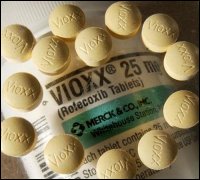
VIOXX CASES ON HOLD IN TEXAS DUE TO NEW RULING

Merck, the manufacturer of Vioxx, is the beneficiary, if only temporarily, of a judge's ruling that the 1,000 personal injury lawsuits in Texas must be delayed or possibly even thrown out because of 2003 tort reform law in that state.

From the AP at Yahoo:

State District Judge Randy Wilson, based in Harris County, granted a motion by Merck & Co. Inc., the drug's manufacturer, to dismiss part of a lawsuit filed by Ruby Ledbetter.

Merck's attorneys argued a 2003 Texas law prevents Ledbetter from claiming she wasn't properly warned about Vioxx.

The law, passed as part of tort reform efforts, says a drug manufacturer is not liable in allegations it failed to provide sufficient warnings about its product if the drug in question came with warnings approved by the Food and Drug Administration.

The law, passed as part of tort reform efforts, says a drug manufacturer is not liable in allegations it failed to provide sufficient warnings about its product if the drug in question came with warnings approved by the Food and Drug Administration.

Friday's ruling put Ledbetter's case, which was set to go to trial in May, on hold.

But Travis Sales, one of Merck's attorneys, and Tommy Fibich, one of Ledbetter's attorneys, both said Wilson had previously told lawyers in the case that such a decision would put all Texas cases on hold until appeals courts rule on the issue.

Wilson, who is presiding over all Vioxx lawsuits filed in Texas, said in his ruling that virtually all the Texas cases allege that Merck failed to provide an adequate warning.

Friday, April 20, 2007

CHINESE ECONOMY CONTINUES GROWING AT BRISK PACE

GDP data released by the Chinese National Bureau of Statistics Thursday shows that the Chinese economy continues to grow at an amazing pace, up 11.1% for the first quarter of 2007 compared to the same time-frame for 2006.


The surge in growth is almost certain to force Beijing to step up efforts to cool the economy. Pressure is also mounting on officials to allow the value of the currency, the yuan, to appreciate more quickly.

Fueled by soaring exports and huge investments in infrastructure, factories and energy supplies, China could soon overtake Germany to become the world’s third-largest economy, behind those of the United States and Japan.

The burst of growth, one of the largest in a decade, came on the heels of four consecutive years of double-digit economic growth, including an increase last year of 10.7%, the fastest annual growth in a decade.

The statistics bureau said that retail sales rose 15%, industrial production was up 18% and exports jumped 28%.

CRIME DOES NOT PAY FOR QWEST'S NACCHIO

Former Qwest CEO Joe Nacchio was convicted yesterday on 19 insider trading counts of the 42 with which he had initially been prosecuted. Each charge carries with it a maximum of 10 years in prison and $1 million fine.


In the latest in a series of convictions against corporate executives, one-time CEO Joe Nacchio was found guilty of illegally selling $52 million in stock amid an accounting scandal that nearly sank Qwest Communications.

Nacchio left the federal courthouse with his wife and son Michael after Thursday's verdict, declining to comment yet determined to appeal the 19 insider trading convictions, each of which carries a sentence of up to 10 years in prison and a $1 million fine.

Nacchio is one of a handful of former Qwest executives who have been convicted of criminal charges stemming from a multibillion-dollar scandal that forced the Denver-based telecommunications company to restate $2.2 billion of revenue.

He also is the latest to be convicted as part of the government's push to punish white-collar executives stemming from accounting fraud at companies from Enron to WorldCom.

"'Convicted felon Joe Nacchio' has a very nice ring to it," boasted Troy Eid, the U.S. attorney for Colorado.

The Justice Department has gone after a number of corporate executives in cases involving accounting and fraud scandals in the late 1990s and 2000 that sparked outrage among investors.

Former Cendant Corp. Chairman Walter Forbes is serving more than 12 years in prison and has been ordered to pay $3.28 billion in restitution. He was convicted of conspiracy to commit securities fraud and other charges in a massive fraud scheme that cost the travel and real estate company and its investors more than $3 billion.

Former WorldCom chief Bernard Ebbers is serving a 25-year prison sentence for his role in the fraud that drove that Clinton, Miss.-based company into bankruptcy in 2002.

Former Enron chief executive Jeffrey Skilling is serving 24 years and four months in prison for fraud and other crimes in the collapse of the former energy giant. Enron founder Ken Lay also was convicted, but a judge vacated that decision when Lay died of a heart attack last year.

HealthSouth Corp. founder Richard Scrushy was acquitted of all charges in a $2.7 billion fraud during his tenure at HealthSouth.

Thursday, April 19, 2007

TICKETMASTER SUES EBAY/STUBHUB

Ticketmaster has sued eBay, parent of StubHub, for violating its exclusive right to sell some tickets at certain venues. From WSJ.com:

Intensifying its long-simmering battle with the burgeoning aftermarket in concert and sporting-events tickets, Ticketmaster yesterday sued eBay Inc. and its StubHub subsidiary, alleging that the reselling site interfered with the company's contractual rights.

While the StubHub lawsuit, filed in Los Angeles County Superior Court, focuses on a particular music tour, it signals Ticketmaster's growing impatience with the so-called secondary ticketing market that has blossomed in recent years as the Internet has made it easy for individuals and companies alike to buy and resell tickets originally generated by Ticketmaster.

The suit alleges that StubHub is currently selling "official premium tickets" to the coming Lynyrd Skynyrd/Hank Williams Jr. "Rowdy Frynds" tour. Sales of those tickets to the public, the lawsuit charges, violates Ticketmaster's exclusive right to sell tickets to events at the venues on the tour, including the Conseco Fieldhouse in Indianapolis and the Palace of Auburn Hills, Mich.

The suit further charges that StubHub, in conjunction with other, unnamed parties, effectively extracted tickets from various client venues by threatening that if tickets weren't made available, those venues "might not be considered as venues for future live-entertainment events."

The suit didn't specify how many tickets were involved. But it does allege that such practices were designed "as part of a larger scheme to diminish Ticketmaster's role in the sale of tickets." Ticketmaster controls the ticket inventory to the vast majority of high-profile concerts and sporting events. Its surcharges have long been the subject of anger on the part of fans.

Ticketmaster executives estimate that around 10% of the most desirable sports and concert tickets are bought by scalpers rather than fans.

Wednesday, April 18, 2007

THE WORLD ACCORDING TO LARRY SUMMERS

Lawrence H. Summers, the former Harvard president and chief economist at the World Bank, may not be overly popular in the United States right now, but he is the toast of Asia, giving keynote speeches at major conferences in China, India, Singapore, and Hong Kong, as well as serving as the only American on a panel mapping the future of the Asian Development Bank.


In a series of visits to China, India, Singapore and Hong Kong since early 2006, Mr. Summers has reiterated several themes that have special resonance in Asia, but have yet to be widely accepted in the United States.

Among them are the idea that growth and changes in Asia are the most important thing to happen during our lifetimes, that the United States and Europe have not yet appreciated the impact of these changes and that the global imbalances from the United States’ current-account deficit — nearly $1 trillion in 2006 — could have severe consequences.

Mr. Summers has been sharply critical of current American fiscal policy and the way that Asia sustains borrowing by the United States by continuing to purchase government debt. During a visit to Mumbai in March last year, Mr. Summers warned the Reserve Bank of India of the United States’ “unsustainable and dangerous” current-account deficit.

In Beijing this January, he asked hundreds of economists and policy makers at a Global Development Network conference to consider the fact that $2 trillion from developing Asia, invested in United States Treasury bills, was making a “zero real return.” Imagine instead, he said “all the opportunities in these countries for productive investment.”

Mr. Summers also visited Singapore for the International Monetary Fund conference in September, then stopped in Hong Kong, where he told those attending an Asia Society dinner that 300 years from now, what will be seen as the most important event of these times will not be the end of the cold war, the terrorist attacks of Sept. 11, 2001, or the war in Iraq, but the “the rise of Asia and all that it meant for people in Asia and all that it meant for the world system.”

The controversy at Harvard, where Mr. Summers’s comments that “intrinsic aptitude” could explain why fewer women than men reach the top ranks in university math and science led to his resignation in February 2006, hardly registered in Asia.

“The gender issues didn’t get much play here,” Mr. Gokarn said.

SURVEY REVEALS MOST SATISFYING CAREERS

From LiveScience at Yahoo!:

Firefighters, the clergy and others with professional jobs that involve helping or serving people are more satisfied with their work and overall are happier than those in other professions, according to results from a national survey.

“The most satisfying jobs are mostly professions, especially those involving caring for, teaching and protecting others and creative pursuits,” said Tom Smith, director of the General Social Survey (GSS) at the National Opinion Research Center at the University of Chicago.

The 2006 General Social Survey is based on interviews with randomly selected people who collectively represent a cross section of Americans. In the current study, interviewers asked more than 27,000 people questions about job satisfaction and general happiness. Individuals' level of contentment affects their overall sense of happiness, Smith said.

Here are the Top 10 most gratifying jobs and the percentage of subjects who said they were very satisfied with the job:

Clergy—87 percent percent
Firefighters—80 percent percent
Physical therapists—78 percent percent
Authors—74 percent
Special education teachers—70 percent
Teachers—69 percent
Education administrators—68 percent
Painters and sculptors—67 percent
Psychologists—67 percent
Security and financial services salespersons—65 percent
Operating engineers—64 percent
Office supervisors—61 percent

Here are the 10 least gratifying jobs, where few participants reported being very satisfied:

Laborers, except construction—21 percent
Apparel clothing salespersons—24 percent
Handpackers and packagers—24 percent
Food preparers—24 percent
Roofers—25 percent
Cashiers—25 percent
Furniture and home-furnishing salespersons—25 percent
Bartenders—26 percent
Freight, stock and material handlers—26 percent
Waiters and servers—27 percent

Tuesday, April 17, 2007

NEW SCAM RIPS OFF ONLINE TAX FILERS OF REFUNDS

From ABC News:

Just before the deadline for personal income tax filings, the Internal Revenue Service is warning consumers of a scam that targets the majority of American taxpayers who file online.

The scheme is so new, the government has no idea how many taxpayers have been bilked. The scam takes advantage of the federal "Free File" program, in which the IRS partners with software makers to allow taxpayers who earn up to $52,000 in taxable income to file electronically for free.

It works like this: Internet grifters send e-mails, luring taxpayers to Web pages that look like IRS-approved sites where they can file their taxes electronically. The scam artists send in the tax returns after redirecting refunds to their own bank accounts instead of those of the taxpayers.

Steven Peisner runs a non-profit identity theft support organization called sellitSAFE.com. He said a 24-year-old Northern California woman contacted him recently after someone else pocketed her $4,000 refund.

"She's pretty much in shock," he said. "And I think that being April 15 is today, I think we have just scratched the surface. And this is just the first victim that I've come in contact with right now. I think in the next couple of months we are going to see hundreds, if not thousands, of victims start to surface. And I think it's going to be a much bigger problem in the next few months."

Monday, April 16, 2007

TOP EXECUTIVE PAY MUCH EASIER TO FIND

In the past, finding out what the CEO or any of the other top few executives of a company made required piecing together data from different documents into a sort of puzzle. It took time and patience, and you never felt certain that you had not missed something. Now, thanks to new laws that require clear disclosure of the pay of the top five executives of publicly traded companies, the information can be found easily and instantly. USA Today lists the total compensation for the CEOs of the largest 150 companies in a simple chart today.

Saturday, April 14, 2007

GOOGLE ACQUIRES DOUBLECLICK

From The New York Times:

Google agreed to its largest acquisition yesterday, reaching a deal to purchase DoubleClick, the online advertising company, from two private equity firms for $3.1 billion in cash, almost double what it paid for YouTube last year. And perhaps just as important, the deal kept DoubleClick from the hands of Microsoft.

For Google, the purchase is another step in its transformation from a search engine into an advertising powerhouse. DoubleClick, which is based in New York City, specializes in software for display advertising and has close relationships with Web publishers, advertisers and advertising agencies.

The sale of DoubleClick involved weeks of negotiation that included at one point Yahoo, AOL and, most prominently, Microsoft, which has been trying to position itself as an advertising rival to Google. Even though Microsoft has more cash on hand than Google, the company was ultimately outbid.

“Keeping Microsoft away from DoubleClick is worth billions to Google,” an analyst with RBC Capital Markets, Jordan Rohan, said. “Yet again, Microsoft is on the sidelines and away from the action.”

Friday, April 13, 2007

CARLOS SLIM HELU WORLD'S SECOND-RICHEST MAN

Carlos Slim Helu has passed Warren Buffett and now ranks just behind Bill Gates as the world's second-richest man. The Mexican telecom tycoon earned $4 billion in the past two months and is less than $3 billion away from taking the number one spot from Gate.

DON IMUS FIRED FROM CBS RADIO

Don Imus raised over $1.3 million for charity today on CBS Radio-owned WFAN in New York, then was fired by the company for the inappropriate remarks he made last week.

From The New York Times:

For four and a half hours this morning, he turned his radio program into a live fundraiser for three charities — two benefiting children with cancer, and the other for families that have lost babies to sudden infant death syndrome — an endeavor he has undertaken each of the last 18 years.

Among the guests were children and parents who had been the beneficiaries of his efforts — particularly the Imus Cattle Ranch for Kids with Cancer, a program that the host founded on his New Mexico ranch along with his wife, Deirdre.

“It was an honor to be at your son’s funeral,” he said to one woman, whose cancer-stricken son had been a guest at what is essentially a western-themed camp for sick children.

At several points, he lashed out at the “hypocrisy” of the media coverage of the fallout from his remarks, and “the lack of support from people like Harold Ford,” the former Tennessee congressman who is black and whom the talk show host had touted repeatedly throughout his recent, failed bid for a Senate seat.

He also expressed bitterness that MSNBC had “pulled the plug” on televising his program less than 12 hours before the fundraiser was to begin. “They got their pound of flesh and made their decision,” he said.

And yet, Mr. Imus also emphasized that, ultimately, he alone was to blame for his predicament.

"I said a stupid, idiotic thing that hurt these kids,” he said of the Rutgers players. “If I hadn’t have said it, we wouldn’t be here. So let’s stop whining about it.”

MARCH SAME-STORE SALES REPORT

Same-store sales results are in for March and the results are mixed. Same-store sales are calculated only for stores that have been in business for more than one year. Here is a breakdown of some popular retailers.

March 2007
Nordstrom +15%
Target +12%
J.C. Penney +10.6%
Saks +10.1%
Limited +8%
Abercrombie & Fitch +7%
Costco +6%
Wal-Mart +4%

The Wal-Mart sales increase was better than expected, but the company has cautioned that April will likely be flat and that quarterly results may not meet expectations.

Wednesday, April 11, 2007

IMUS DROPPED BY MSNBC

Just two days after suspending Don Imus for two weeks for inappropriate remarks, NBC announced today that MSNBC will no longer simulcast the "Imus in the Morning" radio program. Earlier Wednesday American Express, which spent $1.2 million advertising on the show, pulled their ads. General Motors had already stopped advertising on the show for unrelated reasons, but did indicate that they would no longer consider advertising on an Imus program. At this point, Imus is still employed by WFAN, a CBS radio station in New York, where his program brings in 25% of all advertising dollars for the station.

The New York Times

EIA PREDICTS $2.87 AS HIGH FOR SUMMER GAS

The Energy Information Administration issued a report indicating the gasoline will average between $2.81 per gallon this summer. That compares favorably to the $2.84 Americans paid last summer. In addition, the group predicted that the summer high for gas will be $2.87 in May, but many analysts think that the EIA prediction is too low. Gas prices averaged $2.80 last week.

USA Today

CITIGROUP CUTS 17,000 JOBS, SAVES $2.1 BILLION IN 2007


From WSJ.com:

Citigroup Inc., in what's considered its first major overhaul since its formation a decade ago, announced it will save $2.1 billion in 2007 by eliminating 17,000 positions.

The New York financial services giant's long-awaited restructuring will eliminate certain layers of management and reduce its corporate center. Back-office, middle-office and corporate functions will be consolidated, and more than 9,500 jobs will be moved to lower-cost locations, domestically and internationally.

Citigroup sees savings of $3.7 billion in 2008 and $4.6 billion in 2009. It will take a charge of $871 million in the first quarter and pretax charges of $200 million over the rest of 2007. The company will release its first-quarter results Monday.

Over the past year, Citigroup's stock has underperformed hometown rival J.P. Morgan and Bank of America Corp. Last summer, Citigroup's largest individual shareholder, Prince Alwaleed bin Talal, demanded that the company take "draconian" steps to reduce expenses.

Tuesday, April 10, 2007

IMUS REMARKS IMPACT BOTTOM LINE

Last Wednesday radio and television personality Don Imus made inappropriate remarks on his "Imus in the Morning" radio program broadcast on radio throughout the country and on television on MSNBC. By Friday Al Sharpton and Jesse Jackson among others were calling on Mr. Imus to be fired from his broadcasting job. On Monday he was suspended for two weeks, but his employers reserve the right to take further action. Today at least three advertisers, including heavyweight Procter & Gamble, pulled their ads from his show.

From WSJ.com:

The advertisers' reaction suggests fallout over Mr. Imus's remarks could persist. Marketers aren't saying whether their pullouts are permanent, and they are likely to watch carefully to see if the fuss dies down. But the withdrawal of more advertisers could potentially undercut support for Mr. Imus returning to the air. Civil-rights groups such as the NAACP have called for him to be fired, while the Rev. Al Sharpton is calling for advertisers and guests to boycott the program.

Mr. Imus has long been known for his irreverent humor, but he has come under intense criticism since referring to the Rutgers team, which lost to the University of Tennessee in the NCAA championship last week, as "nappy-headed hos" during his show. Mr. Imus went onto Mr. Sharpton's radio program on Monday to apologize, but the controversy hasn't let up. Talkers, a trade publication, estimates Mr. Imus has a radio audience of about 2.25 million, placing him among the nation's top 25 radio personalities.

Monday, April 02, 2007

EMI AND APPLE TO OFFER DRM-FREE SONGS

From USA Today:

Apple and EMI Music shook up the music industry Monday by announcing plans to sell more than 150,000 digital songs without copy protection.

The songs — from Coldplay, Norah Jones, and other artists on the giant EMI record label — can be freely copied. They'll play on many different kinds of music players and can be easily burned to CD.

But music-lovers will pay more for them. iTunes, Apple's digital music store, plans to offer the songs in May for $1.29 each. Standard iTunes songs, which will still be available, cost 99 cents.

Apple CEO Steve Jobs says other record labels will be forced to follow EMI's lead. "I expect to have 2.5 million to 5 million (copy protection-free) songs by the end of the year," Jobs says.

CHICAGO TRIBUNE SOLD TO SAM ZELL

From ChicagoTribune.com:

After an epic corporate drama, Chicago's Tribune Co. sold itself in a deal that puts the 159-year-old media conglomerate in the hands of the city's most iconoclastic entrepreneur, setting up a high-stakes bet that a pillar of the nation's old-media establishment can tug itself into the digital future without toppling over.
Early Monday, following a weekend of heated negotiations, the company's board accepted a revised $34-dollar-a-share proposal from Chicago real estate magnate Sam Zell to take the company private in a complex, $8.2 billion deal structured around an employee stock ownership plan.

In addition, the Tribune said it intends to sell the Chicago Cubs and its 25 percent stake in local sports cable channel Comcast SportsNet Chicago.

Wednesday, March 28, 2007

U.S. INCOME GAP GETS WIDER IN 2005

This is from a New York Times article describing a data analysis by Professor Emmanuel Saez of the University of California Berkeley and Professor Thomas Piketty of the Paris School of Economics:
  • Income inequality grew significantly in 2005, with the top 1 percent of Americans — those with incomes that year of more than $348,000 — receiving their largest share of national income since 1928.
  • The top 10 percent, roughly those earning more than $100,000, also reached a level of income share not seen since before the Depression.
  • While total reported income in the United States increased almost 9 percent in 2005, the most recent year for which such data is available, average incomes for those in the bottom 90 percent dipped slightly compared with the year before, dropping $172, or 0.6 percent.
  • The gains went largely to the top 1 percent, whose incomes rose to an average of more than $1.1 million each, an increase of more than $139,000, or about 14 percent.
  • The top 300,000 Americans collectively enjoyed almost as much income as the bottom 150 million Americans.
  • Per person, the top 300,000 Americans received 440 times as much as the average person in the bottom half earned, nearly doubling the gap from 1980.
  • The top 10 percent of Americans collected 48.5 percent of all reported income in 2005. That is an increase of more than 2 percentage points over the previous year and up from roughly 33 percent in the late 1970s. The peak for this group was 49.3 percent in 1928.
  • The top 1 percent received 21.8 percent of all reported income in 2005, up significantly from 19.8 percent the year before and more than double their share of income in 1980. The peak was in 1928, when the top 1 percent reported 23.9 percent of all income.
  • The top tenth of a percent reported an average income of $5.6 million, up $908,000, while the top one-hundredth of a percent had an average income of $25.7 million, up nearly $4.4 million in one year.

NORTH KOREA ISSUING COUNTERFEIT U.S. CURRENCY

Bloomberg is reporting today that one of the problems holding up the six-party talks over North Korea's nuclear weapons program is the accusation that the North Korean government is printing counterfeit U.S. $100 bills. The United States has known of the fake $100 bills which are often called "supernotes" since 1989 and has confiscated approximately $50 million of the counterfeit bills. A Korean newspaper/website doing research on a story about the supernotes was able to obtain one, which is pictured below. The bills can be purchased for $70 each and are very difficult to detect. The United States has frozen North Korean assets held in at least one bank due to concerns that the bank is helping to launder money for the North Korean government. Many have speculated since 1989 that the United States will issue new and different $100 bills and might require that all old $100 bills be exchanged and destroyed, rendering the counterfeits worthless.

Daily NK

Tuesday, March 27, 2007

MERCK WINS ILLINOIS VIOXX TRIAL

An Illinois jury ruled today that Merck's drug Vioxx was not responsible for the deadly heart attack of a 52-year-old woman in 2003. Merck had argued that the woman's weight and other health issues were the primary reason for her death. The victory for the drug maker was the 10th out of 15 trials. There are now over 27,000 personal injury lawsuits and another 265 potential class-action lawsuits filed against Merck all stemming from the formerly popular drug Vioxx. Merck has set aside $1.64 billion to fight the cases.

USA Today

Friday, March 23, 2007

VONAGE MUST STOP USING VERIZON PATENTS

A federal judge issued a permanent injunction against Vonage forcing the VoIP phone company to stop using Verizon's patented technology. From The New York Times:

Judge Claude Hilton said an injunction, which followed a jury decision that Vonage had infringed on three Verizon patents, is required because simply providing monetary damages ''does not prevent continued erosion of the client base of the plaintiff.''

Hilton said he will not formally enter the injunction for another two weeks while he considers Vonage's request to stay the injunction. Vonage is requesting a stay of either 120 days or until its appeal is heard.

But Verizon lawyer Dan Webb said any of Vonage's business difficulties should not be a factor in determining a stay. Webb said a stay will cause irreparable damage to Verizon because Vonage will continue to lock up the marketplace of Voice over Internet Protocol, or VoIP.

Vonage stock lost nearly 26% of its value today as investors worried that the company may not be able to continue to provide service without the use of Verizon's technology.

Wednesday, March 21, 2007

NEW DETAILS ON SIRIUS/XM PRICING AFTER MERGER

Newly filed FCC documents show that IF, and that is a big IF, the merger between Sirius and XM is approved, prices for some services will increase, others will remain the same, and some will be lower. Here is the breakdown from an AP story at The New York Times.

Lower Price
For customers who choose to receive fewer channels than they currently receive, prices will decrease from the $12.95 monthly rate. Which channels and how much the price will drop is not detailed. Currently, customers can choose to block certain channels like the Playboy channel, but they do not receive a discount for doing so.

Same Price
For customers who choose to keep their same service, expect the price to remain the same.

Higher Price
Customers who choose a "best-0f" service from both providers can expect to pay a "modest premium" above the regular $12.95 fee.

Also from the article:
Sirius and XM were explicitly forbidden from merging when their licenses were granted a decade ago, but the companies are arguing that much has changed since then, and that the companies now face increased competition in audio entertainment from iPods and Internet radio, as well as traditional terrestrial radio.

On Tuesday, a group of six consumer and advocacy groups asked the Senate panel to call for a tough regulatory review of the transaction, which would eliminate one of the only two competitors in the emerging satellite radio business.

The statement from Consumers Union, the Consumer Federation of America and others said that the deal would reduce competition, decrease choices for consumers and possibly lead to higher prices.

Friday, March 16, 2007

BALLY TOTAL FITNESS TO SEEK CHAPTER 11 BANKRUPTCY PROTECTION?

Shares of Chicago-based Bally Total Fitness sank 60% in trading today as the company announced it may file for Chapter 11 reorganization soon. The company has $827 million in outstanding debt with $300 million more coming due in October and only $45 million in cash.

Monday, March 12, 2007

HALLIBURTON MOVING HEADQUARTERS TO DUBAI

Oil services and defense contractor Halliburton announced on Sunday that they will relocated corporate headquarters from Houston to Dubai in the United Arab Emirates. Halliburton will maintain its legal registration in the United States and will keep some offices in Houston, but the CEO and other top executives will transfer to Dubai.

Halliburton has been the target of criticism as some have alleged that the company benefits unfairly because of its relationship with Vice President Dick Cheney, the former CEO of Halliburton. Also, last month federal investigators alleged that Halliburton was responsible for $2.7 billion in contractor waste and overcharging in Iraq.

GreatDreams.com
USA Today

Friday, March 09, 2007

WAL-MART SAME-STORE SALES DISAPPOINTING

On Thursday Wal-Mart reported weak same-store sales for February, continuing its sales slump that began last year.

From USA Today:

Also Thursday, Wal-Mart's board approved a 31% increase in the company's dividend, bringing the annual payout to 88 cents a share from 67 cents a share. The world's largest retailer said it plans to return more than $3.6 billion to its shareholders in the form of dividends during fiscal 2008, based on the expected dividend increase.

Same-Store Sales February 2007
Wal-Mart +0.4%
Sam's Club +3.9%
Target +5.7%
Costco +4.0%

VONAGE VIOLATES VERIZON PATENTS - MUST PAY $58 MILLION FINE

From USA Today:

Internet phone provider Vonage must pay Verizon $58 million in damages for infringing on three of the phone giant's technology patents, a jury ruled on Thursday. The U.S. District Court in Virginia has scheduled a March 23 hearing to determine whether Vonage can continue to use the patented technology — which goes to the heart of how it provides low-cost Internet telephone service to more than 2 million customers. If the court lets Vonage use the technology, then it must pay Verizon 5.5% of total revenue on an ongoing basis, the jury ruled. That could tack an additional $47 million to $50 million onto Vonage's tab this year.

GATES AND BUFFETT STILL TOP FORBES RICHEST LIST

Bill Gates is the world's richest man for the 13th year in a row and his pal Warren Buffett is second once again, but Mexican businessman Carlos Slim Helu is quickly gaining ground on both men and may be poised to take the crown next year. Helu gained an amazing $19 billion last year and now sits only $7 billion below Gates and $3 billion below Buffett.

From USA Today:

After a 20-year reign, Japan is no longer Asia's top spot for billionaires: India has 36, worth a total of $191 billion, followed by Japan with 24, worth a combined $64 billion. India's rich are also marching toward the top of our rankings. Brothers Mukesh and Anil Ambani, who split up their family's conglomerate in 2005, join Lakshmi Mittal, who heads the world's biggest steel company, Arcelor Mittal, among the world's 20 wealthiest. India now has three in the upper echelons, second only to the U.S.

Ingenuity, not industry, is the common characteristic; these folks made money in everything from media and real estate to coffee, dumplings and ethanol. Two-thirds of last year's billionaires are richer. Only 17% are poorer, including 32 who fell below the billion-dollar mark. The billionaires' combined net worth climbed by $900 billion to $3.5 trillion. That equates to $3.6 billion apiece.

The average billionaire is 62 years old, two years younger than in 2005. This year's new billionaires are seven years younger than that. Of list members' fortunes, 60% made theirs from scratch.

Forbes pinned down a record 946 billionaires. There were 178 newcomers, including 19 Russians, 14 Indians, 13 Chinese and 10 Spaniards, as well as the first billionaires from Cyprus, Oman, Romania and Serbia.

Monday, March 05, 2007

SENATOR CLINTON EXPRESSES CONCERN ABOUT FOREIGN-OWNED U.S. DEBT

Senator Hillary Clinton expressed concern about the "economic vulnerabilities" posed by foreign interests owning large amounts of U.S. debt. On the Senate floor, and in letters to Federal Reserve Chairman Ben Bernanke and Treasury Secretary Henry Paulson, Senator Clinton said that President Bush's economic policies have contributed to an "erosion of U.S. economic sovereignty" and added that it is "undeniable that the exponential growth of foreign debt in the last six years has undermined our economic standing."


Currently, the U.S. imports more goods than it exports from places like China, resulting in a trade deficit, and it borrows heavily from abroad to finance its domestic investment. Foreign interests own about $2.2 trillion of U.S. Treasury securities -- or about 52% of the public debt not held by the U.S. government, compared with about 20% in the early 1990s, during the Clinton administration. The U.S. has come to rely on foreign capital because Americans don't save enough to finance the nation's domestic investment.

...there is broad concern that the growing reliance on foreign investors puts the U.S. at risk, and some say the way to address it is to begin saving money at home by erasing the current $248 billion budget deficit, moving into a surplus and putting money aside to pay for costly obligations like Social Security and Medicare.

BARRON'S PICKS TD AMERITRADE AS #1 ONLINE BROWSER-BASED BROKER

In the March 5th Barron's, TD Ameritrade rates as the #1 online broker in the 12th annual ratings. Baron's broke firms into two categories, browser-based and software-based online brokers. While TD Ameritrade won the browser-based category, thinkorswim took first place in the software-based contest.

Friday, March 02, 2007

WORST WEEK FOR U.S. STOCKS IN MORE THAN FOUR YEARS

The Dow Jones Industrial Average fell 4.2% this week, the S&P 500 dropped 4.4%, and Nasdaq was down a whopping 5.9%. For the DJIA and S&P 500 it was the worst week points-wise since July of 2002 and the Nasdaq experienced its biggest points decline since September of 2001. Overall, U.S. stocks had experienced 45 consecutive months without a drop of 2% in a single trading session, that is until Tuesday of this week when the slide began.

Thursday, March 01, 2007

SIRIUS CEO TESTIFIES BEFORE THE HOUSE JUDICIARY COMMITTEE

Sirius Satellite Radio CEO Mel Karmazin testified Wednesday before the House Judiciary Committee in a review of the proposed merger between XM and Sirius. In his testimony, Karmazin vowed not to raise subscription fees, but rather to lower them, which at least one member of the committee found unbelievable. From The Wall Street Journal:

Rep. John Conyers (D., Mich.), chairman of both the Judiciary Committee and the task force, was skeptical. "We don't have too good a record of satellite companies keeping their promises," Mr. Conyers said. "'Trust me' isn't going to work here, not just today, but in the longer-term examinations you will be going through."

Other members thought the deal might receive approval, but only if Sirius and XM agree to:

  1. allow customers to choose stations on a channel-by-channel basis or a tiered format similar to cable TV.


  2. make 5% of the channel capacity available for noncommercial, educational purposes.


  3. freeze prices for at least three years.

Karmazin did not seem to think that it would be possible to allow channel-by-channel or tiered subscriptions, and was noncommittal on how long rates could be frozen, suggesting a possible maximum of four years.

Wednesday, February 28, 2007

DaimlerChrysler NEARS DEAL TO BRING CHINESE AUTOS TO UNITED STATES & EUROPE

From USA Today:

Chrysler Group moved a step closer Tuesday to becoming first to bring Chinese-made cars to the USA. German parent DaimlerChrysler approved a deal to team with Chinese carmaking phenomenon Chery Motor to develop small cars that could be sold in the USA and Europe. If the Chinese government approves the deal as expected next month, Chrysler's Chinese-made cars could be on American roads within a couple of years, Chrysler spokesman Dave Elshoff says. The partnership will focus on developing a car tinier than the Dodge Caliber, currently the smallest vehicle in the Chrysler lineup. The new car would be more the size of Chevrolet Aveo or Honda Fit. As automaking goes, Chery's success has been the stuff of legend. From a start only eight years ago, it is ranked fourth among Chinese automakers with sales of 302,000 vehicles last year, says John Humphrey, senior vice president of Asian-Pacific operations for J.D. Power and Associates. It grew 60% in 2006.

Sunday, February 25, 2007

MICROSOFT LOSES $1.5 BILLION PATENT LAWSUIT

Microsoft was ordered to pay $1.5 billion for patent infringement to Alcatel-Lucent in a verdict rendered Thursday. The patents involved in the case deal with converting audio into digital MP3 files on a computer. Microsoft claims to have paid $16 million to Fraunhofer-Gesellschaft, a German research company, to acquire the rights to the technology. Microsoft claims that Fraunhofer-Gesellschaft is the rightful and internationally recognized licensor of the technology used and nothing is owed to Alcatel-Lucent.

USA Today

Friday, February 23, 2007

RULE #1 - A GREAT WAY TO LEARN ABOUT INVESTING

Many of you have asked me investment questions, some pertaining to the stock project, others regarding personal investments you are considering. I'm reluctant to give specific advice, but I do recommend that anyone interested in investing should start reading good books to educate themselves. In my opinion, none are better than Phil Town's Rule #1. Mr. Town writes in a manner that is easy to read, informative, and very entertaining. I'm not going to pretend that everyone who buys and reads Rule #1 will make $1 million in a short time, but it is a great way to get started in educating yourself about investing for your future. I've read it. I loved it. I recommend it to everyone.

Thursday, February 22, 2007

APPLE AND CISCO REACH DEAL ON iPHONE TRADEMARK

When Steve Jobs announced the Apple iPhone in January, it was a bit premature to be using the name iPhone because Cisco owned a trademark on it and Apple had not reached an agreement to use the name. Last night, both companies announced that they had reached a deal to allow Apple and Cisco to use and market products under the iPhone name. Specific terms of the agreement were not released, but it was announced that Apple and Cisco will explore making their products more compatible.

Wednesday, February 21, 2007

XM AND SIRIUS SATELLITE RADIO TO MERGE?

On Tuesday the rumors that had swirled for more than a year regarding a possible merger between the two satellite radio companies in the United States, XM and Sirius Satellite Radio, were confirmed when both companies announced they are interested in a "merger of equals". There will be numerous hurdles to overcome before the companies can merge.
  1. The Federal Communications Commission will have to approve the merger. They will take into consideration what is in the best interest of the public and if they do green light the merger, they might require concessions such as being able to regulate satellite radio like the currently do with terrestrial radio and requiring XM and Sirius to give back some of the radio spectrum issued to them by the FCC.
  2. The Federal Trade Commission's Bureau of Competition seeks to prevent business practices that restrain trade. They get their charge and power from the FTC Act and Clayton Act, both of 1914. If the Bureau of Competition determines that consumers could lose in a scenario in which there was only one provider of satellite radio, the merger would likely not be approved.
  3. The Antitrust Division of the Department of Justice will look closely at the proposed merger, consulting with the FTC to streamline the process and avoid duplication. If the DOJ believes that the merger would be a violation of the Sherman Antitrust Act of 1890 and/or the Clayton Act of 1914, the merger would likely not be approved.

Going from two competing satellite radio companies to one merged company seems to violate antitrust laws - one provider of a good or service that lacks a viable substitute - but XM and Sirius will argue that they do have competitors and substitutes in terrestrial radio, internet radio, and iPods and other portable music devices including mobile phones.

Most proposed mergers take a few months to clear all of the hurdles, but this one will likely take much longer, possibly going into 2008 before a final decision is rendered.

WSJ.com
USA Today

Monday, February 19, 2007

SHAREHOLDERS STARTING TO USE THE POWER OF THE VOTE

Most business students are surprised to learn that shareholders have very little power in most publicly traded companies. They aren't allowed to dictate CEO or other executive pay, they aren't allowed to nominate their own board candidates in many cases, and there is little they can do to stop boards that are too cozy with executives from creating severance packages that are far too generous (see Nardelli at Home Depot and McKinnell at Pfizer). This might be the year that some of that changes. USA Today reports that shareholders are prepared to flex their muscles this year and possibly make big changes shaking up the corporate landscape. On their radar:
  1. Being allowed to nominate their own slate of board candidates, not merely vote for the slate put forward by the company.
  2. Being allowed to vote for executive compensation in a non-binding manner, as is required in the United Kingdom.
  3. Requiring more than 50% of the vote to be elected to the board. Currently, in many companies, unopposed directors can be elected with a tiny percentage of the vote.
  4. Getting more of a say in global warming issues. There are 42 global-warming-related resolutions up for vote this year.

CHRYSLER: $35 BILLION IN 1998 TO $5 BILLION IN 2007

DaimlerChrysler is looking to potentially sell ailing U.S. automaker Chrysler, spin the unit off to existing shareholders, get involved with strategic alliances and joint ventures to cut costs and expand sales, and/or restructure the company once again, according to The Wall Street Journal. Chrysler was valued at $35 billion in 1998 when Daimler-Benz AG merged with Chrysler to form DaimlerChrysler. Today, analysts put the price tag for Chrysler around $5 billion.

Friday, February 16, 2007

NORTHWEST AIRLINES FILES REORGANIZATION PLAN

Northwest Airlines filed its plan for emerging from Chapter 11 bankruptcy on Thursday. The company filed for bankruptcy protection in September of 2005 and has eliminated $2.4 billion in annual operating costs, $1.35 billion coming from labor concessions. According to the plan, unsecured creditors are expected to receive between 66% and 83% of the value of their claims against the company.

Wednesday, February 14, 2007

AFLAC TO ALLOW SHAREHOLDERS TO VOTE ON EXECUTIVE PAY

Aflac will become the first major U.S. company to let shareholders vote on executive pay. The vote will be for the pay packages of the top five executives and will be non-binding. In the United Kingdom, the law requires that shareholders vote on executive compensation causing CEO pay to be more in line with performance. Shareholders in the U.K. rarely vote down proposed pay packages, which when presented to shareholders are much less generous than many U.S. executive pay packages.

ONE "BAD APPLE" CAN SPOIL THE WHOLE OFFICE

Researchers at the University of Washington have come to the conclusion that having just one "bad apple" in the workplace can cause negative behavior to spread like a virus, bringing down coworkers and destroying good teams. In the study, a bad apple was defined as someone who was chronically unhappy and emotionally unstable, or a bully who attacks others, or someone who does not do his/her fair share of the work. What should businesses do to weed out bad apples before they become a problem? If one is already hired, consider putting him/her on projects that do not require teamwork and keep him/her away from the team. In the hiring process, a more thorough screening process that includes checking references and administering personality tests could help businesses identify candidates who are disagreeable and lack emotional stability.

Reuters

Saturday, February 10, 2007

TOP HEAD ROLLS AT CARTOON NETWORK

The president and general manager of Cartoon Network, Jim Samples, resigned under pressure Friday following the incident on January 31st that caused Boston to shut down subway, highway, and river traffic due to fear that some of the 40 blinking signs for the "Aqua Teen Hunger Force" series and movie were thought to be potential terrorist weapons. Samples had worked at Cartoon Network for 13 years.

From WSJ.com:

"I deeply regret the negative publicity and expense caused to our company as a result of this campaign," Mr. Samples wrote in an email to Cartoon Network employees. "I feel compelled to step down .. in recognition of the gravity of the situation that occurred under my watch."

EXECUTIVE PAY BECOMING A SERIOUS ISSUE

How does a $210 million severance package sound? $200 million? Well, Robert Nardelli did a poor job of running Home Depot and got pushed out of the executive suite recently, but was handed the $210 million king's ransom on his way out the door. Henry A. McKinnell did perhaps an even worse job of running Pfizer. His reward? A cool $200 million.

Things have gotten so bad on the executive pay front that even President Bush has recently weighed in on the issue. In a speech on Wall Street in January he said that corporate board members "need to pay attention to the executive compensation packages that you approve."

From the AP:
Rep. Barney Frank, D-Mass., chairman of the House Financial Services Committee, is expected to introduce legislation on the issue. Frank said in a January speech at the National Press Club that high CEO pay is "not just a matter of envy. It has reached a point where it has some macroeconomic significance."

Frank pointed to research done by Harvard professor Lucian Bebchuk showing that compensation of the top five officers at the country's public companies between 1993 and 2002 totaled about $250 billion — nearly 10 percent of aggregate profits. CEO pay grew by a median 11.29 percent in 2005, according to The Corporate Library, which tracks governance, compensation and performance.

Wednesday, February 07, 2007

SNICKERS DROPS "MECHANICS KISSING" AD


The ninth-ranked Super Bowl ad according to USA Today's Ad Meter has been pulled by the makers of Snickers. It will no longer run on television and has been deleted from the Snickers website, although it is widely available on other sites. The ad was pulled after several organizations that represent gays and lesbians complained that it was offensive.

From USA Today:

Among groups who complained is the Gay & Lesbian Alliance Against Defamation. "Mars needs to apologize for the deplorable actions of its Snickers brand," said GLAAD President Neil Giuliano in a statement.

But not all gay activists object to the ad. Cyd Zeigler, co-founder of Outsports.com, a website for gay sports enthusiasts, says he saw it at a Super Bowl party with 30 gay friends — and no one had a problem with it. "I simply wasn't offended by it," Zeigler says. "I just don't see how a couple of mechanics pulling out chest hair because they kissed is offensive."

Still, he thinks that Masterfoods would be wise to apologize. "They're a business," he says. "And no company in a free market is in the business of alienating consumers, intentional or not."

Monday, February 05, 2007

ANHEUSER-BUSCH WINS SUPER BOWL AD BATTLE

Anheuser-Busch won USA Today's Super Bowl Ad Meter battle for a record ninth consecutive year. AB had the highest rated ad, four of the top five, and seven of the top ten ads, making the most of their $20+ million investment. The winning ads were produced by the superstar ad agency DDB Chicago. To view all of the ads at USA Today click here. Anheuser-Busch also has the top five rated ads on the WSJ.com site according to an online opinion poll.

Friday, February 02, 2007

JANUARY UNEMPLOYMENT RISES TO 4.6%

The Department of Labor released the January 2007 unemployment data today showing that unemployment rose from 4.5% in December to 4.6%. Some highlights of the report:
  • 111,000 net new jobs were added to non-farm payrolls, 104,000 of those in the service sector.
  • 16,000 factory jobs were lost in January, the seventh straight monthly decline.
  • 22,000 construction jobs were added in January.
  • Average hourly earnings rose 0.2% to $17.09 per hour.
  • Over the past year, hourly and weekly earnings have risen 4%.
  • The unemployment rate for Hispanics rose to 5.7% from 4.9% in December.
  • The unemployment rate for African Americans dropped to 8% from 8.4%.
  • The unemployment rate for whites rose to 4.1% from 4%.

USA Today
WSJ.com

Thursday, February 01, 2007

FEDERAL RESERVES LEAVES RATES AT 5.25%

On Wednesday, the Federal Reserve left the Federal Funds Target Rate unchanged at 5.25%. That is the highest rate in six years. After increasing the rate 17 consecutive times from June 2004 to June 2006, the Fed has now left it unchanged for five consecutive meetings.

MICHAEL DELL TAKES OVER AS CEO AT DELL

When Michael Dell handed over the CEO title to Kevin Rollins in 2004, he remained as chairman of the board. Yesterday, after Rollins resigned, Michael Dell took back over as CEO and will remain as chairman. Even though the company has endured some bad times and just announced that it will miss fourth quarter revenue and earnings estimates, after it was announced the Michael Dell was taking over, the stock rose $1, or 4.1%.

WSJ.com
USA Today

Wednesday, January 31, 2007

MICROSOFT HAS BEST REPUTATION WITH CONSUMERS

The eighth annual survey to determine the U.S. corporations with the best and worst reputations showed that Microsoft jumped from number seven in 2005 to number one in 2006. While there is much to take away from the survey, it is interesting to note the Wal-Mart fell from 29th in 2005 to 40th in 2006.

WSJ.com

INITIAL U.S. GDP FIGURES SHOW 3.4% GAIN IN 2006

The Commerce Department released its initial fourth quarter gross domestic product figures this morning showing a 3.5% seasonally adjusted annualized growth rate for October through December of 2006. That bested a 2% growth in the third quarter and put the initial 2006 GDP growth at 3.4%, compared to 3.2% in 2005 and 3.9% in 2004.

A closer look at the data released shows that an important inflationary statistic, personal consumption expenditures (PCE), actually declined in the fourth quarter at an annual rate of 0.8%, the biggest drop since 1954 and the first since 1961.

From USA Today:
Excluding volatile food and energy prices, the so-called core PCE index was
up at a 2.1% annual rate, still slightly above the Fed's assumed comfort range
of 1% to 2%. Economists were expecting the core PCE index to advance 2.2%.

WSJ.com

Monday, January 29, 2007

MICROSOFT'S WINDOWS VISTA ON SALE TUESDAY

Microsoft's newest operating system, Windows Vista, intended to replace Windows XP, will become available to consumers at some retailers starting at 12:01 a.m. Tuesday morning. The operating system has been available to many corporate clients since November. Most reviews I've read indicate that while it is a major advance, most consumers should stick with Windows XP on older computers instead of upgrading and wait to get Windows Vista preinstalled on their next new computer. Many of the more sophisticated features in Vista require more memory than most older computers have and a high-end graphics card.

USA Today

SUPER BOWL ADS GENERATE PROFIT ONLINE

Most people have heard that CBS is charging up to $2.6 million for one 30-second ad spot on the Super Bowl. The hefty price tag can be justified by the likely 90 million viewers in a fragmented television landscape where more viewers have migrated to niche cable shows and many view less TV to spend time playing video games or surfing online.

What most people probably don't know is that sites like USA Today and IFilm have started charging for "pre-roll" ads, ads that will have to be viewed before Super Bowl ads when surfers go to those sites to view Super Bowl ads after the game. In 2006, IFilm's site experienced a 157% surge in traffic the week after the Super Bowl going from 1 million unique visitors the week before to 2.6 million the week after the game.

WSJ.com

Sunday, January 28, 2007

INTEL & IBM BREAKTHROUGH TO EXTEND MOORE'S LAW

Gordon Moore, co-founder of Intel, predicted in 1965 that innovations in integrated circuit materials, designs, and other innovations would allow for the number of transistors on an integrated circuit to double every two years. This is known as Moore's Law. An announcement on Friday by IBM and Intel should extend Moore's Law into the foreseeable future. The innovation uses a new exotic material in the manufacture of integrated circuits and will allow chips to be made with circuitry as small as 45 nanometers, which is 1/2000th the width of a human hair.

Reuters

Wednesday, January 24, 2007

PRESIDENT BUSH UNVEILS HEALTH INSURANCE PLAN DETAILS IN STATE OF THE UNION ADDRESS

As expected, President Bush outlined some details of his controversial health insurance plan in last night's State of the Union Address. His plan calls for an end to tax-free premiums in employer-provided health insurance plans, making the premium paid taxable income. To offset some of the tax burden, all taxpayers who either have employer-provided health insurance or purchase their own insurance would receive a deduction of $15,000 for a family plan or $7,500 for an individual. Currently, the average cost of an employer-provided family plan is $11,500, while the average for individual plans is $4,300.

From USA Today:

"For a lot of people, it would be a bonanza," says Joe Antos of American Enterprise Institute. He and other supporters of the plan say it would encourage employers to offer less-generous insurance plans. They say generous plans drive up the cost of health care.

Paul Fronstin of the Employee Benefit Research Institute says the proposal might lead more employers to drop coverage. Some employers might also find that younger, healthier workers would opt out of company plans to buy their own insurance, leaving sicker, more expensive workers behind, he says.

Tuesday, January 23, 2007

YAHOO TO REPORT EARNINGS TODAY

Yahoo will report fourth quarter earnings today and will likely give an update on the slow customer migration from its old keyword search advertising to the new "Panama" system, which works much more like Google's Adwords. Investors hope Panama will help Yahoo narrow the growing gap in online ad sales.

Saturday, January 20, 2007

PRESIDENT BUSH PROPOSES HEALTH INSURANCE TAX CHANGES

In his weekly radio address this morning, President Bush said that he wants to change tax codes to make insurance more affordable for the uninsured. From The Wall Street Journal:

"Rising health care costs are making insurance too expensive for millions of our citizens," Mr. Bush said Saturday in his weekly radio address. To remedy the situation without hiking taxes or creating a new entitlement program, he says the tax code can be rewritten to treat health insurance more like home ownership.

"The current tax code encourages home ownership by allowing you to deduct the interest on your mortgage from your taxes," Mr. Bush said. "We can reform the tax code, so that it provides a similar incentive for you to buy health insurance."

Mr. Bush didn't outline the nuts and bolts of his tax-code proposal, but it is expected to include capping some taxpayers' ability to exclude employer-based healthcare benefits from their income, subjecting them to federal income tax. Savings could go toward tax credits for lower-income people who buy health insurance or for state insurance pools.

Altering the tax benefits for employer-provided health care involve far-reaching changes to the tax code affecting millions of taxpayers and companies. Bush's Advisory Panel on Federal Tax Reform proposed in November 2005 to limit the tax benefit for employer-provided health care to $11,500 for families and $5,000 for singles. The recommendation, which has languished with the tax panel's other reform proposals, came after witnesses told the tax panel the existing federal tax subsidies for health insurance were benefiting rich workers while raising insurance prices for the poor and increasing the number of uninsured.

Thursday, January 18, 2007

GM SALES DOWN 1% IN 2006

General Motors announced that sales declined 1% from 2005 to 9.09 million vehicles in 2006. Part of the decline can be attributed to rental car companies purchasing 75,000 fewer vehicles from the company last year. A closer look at the numbers shows that sales outside of the United States actually increased last year to 4.97 million, 55% of the total vehicles sold.

Rival Toyota estimates that it sold 8.8 million vehicles in 2006 and plans to build 9.42 million in 2007. Recently, most analysts have predicted it is a matter of when, not if, Toyota sells more vehicles than GM and takes over the global leader.

USA Today

STARBUCKS DROPPING GROWTH HORMONE MILK

Responding to criticism from consumer groups concerned about the lack of testing and data regarding rBGH, a growth hormone given to some dairy cows to increase milk production, Starbucks has pulled growth hormone milk products from many of its stores and is expected to go companywide when new milk sources can be found. Earlier this month Starbucks announced it would quit selling food containing trans fats at half of the company's U.S. outlets. Starbucks has a long history of responding to consumer requests and is known as a leader in corporate social responsibility.

From USA Today:

Starbucks Coffee is ending its use of milk products that contain an artificial growth hormone, starting in much of the West and New England. Less than a month after announcing that the chain would stop selling items with trans fats in half its U.S. stores, Starbucks said Tuesday it had begun buying only milk products without bovine growth hormone in those areas. Starbucks has not raised prices and is working with suppliers on the cost of milk, half and half, whipping cream and eggnog, spokeswoman Sanja Gould told the Seattle Post-Intelligencer. Starbucks has 5,668 stores in the United States, but the number affected by the change was not immediately available. It covers company-owned Starbucks outlets in Washington, Oregon, Idaho, Alaska, Montana, Northern California and New England. Earlier this month Starbucks announced plans to stop selling food containing trans fats at half the company's U.S. outlets. The move comes after Starbucks was targeted in a campaign by consumer groups critical of the use of an artificial hormone known as rBGH, which is given as a supplement to dairy cows to increase milk production. For more than a decade, some advocacy groups have asserted that there has not been enough research on the effects in humans of milk products from cows that were given the hormone, which is administered to dairy cattle during the middle phase of lactation to boost milk production. "We are actively engaged with all our dairy suppliers to explore converting our core dairy products to be rBGH-free in our U.S. company-owned stores," Starbucks spokesman Brandon Borrman told Reuters. "It is something we're aiming for."

Wednesday, January 17, 2007

SIRIUS & XM SATELLITE RADIO CONSIDERING MERGER?

According to The Wall Street Journal, rivals Sirius Satellite Radio Inc. and XM Satellite Radio Holdings Inc. seem to be considering a merger, but any combination of the only satellite radio providers would face serious legal and regulatory antitrust hurdles from the Justice Department Antitrust Division, the Federal Trade Commission and the Federal Communications Commission. According to Reuters, FCC Chairman Kevin Martin today said, "There's a prohibition on one entity owning both of those licenses," making a merger seem unlikely, but he did leave the door open by saying that the FCC would review any transaction submitted to it.

While Sirius and XM are the only satellite radio providers in the United States, they might be able to get over most antitrust and competition hurdles by arguing that satellite radio competes with traditional terrestrial radio, MP3s, Internet radio, and even cellphones.

While both Sirius and XM have added millions of users, totalling more than 12 million, neither has approached profitability. In the past 12 months, Sirius stock price has fallen more than 35% while XM has dropped more than 40%.

Tuesday, January 16, 2007

DEBIT CARDS: PIN USE VERSUS SIGNATURES


Here are a few facts regarding debit cards from The Wall Street Journal:
  • According to Visa, a typical supermarket pays 24 cents in fees when a customer buys $40 in groceries with a debit card using a PIN.
  • The same $40 purchased with a debit card using a signature costs the supermarket 35 cents in fees.
  • If the customer uses a credit card to make the same $40 purchase, the supermarket may pay more than 50 cents in fees.
  • Electronic payments (debit and credit transactions) surpassed the use of cash and checks for the first time in 2003.
  • Nearly 67% of the 6.2 billion transactions processed by Visa in the three months ended September 30 were debit card transactions.
What does this mean for businesses?
  1. Consumers prefer to make electronic payments, so nearly all businesses must offer this option.
  2. Fees for debit PIN transactions are lowest, so nearly all businesses should have a PIN touch pad. Currently there are about six million merchant locations that accept credit and debit card payment, but only about two million have the pad technology in place to allow for PIN transactions.
  3. To strongly encourage debit PIN transactions, payment terminals that scan cards should automatically default to PIN for scanned debit cards.
To most consumers, the difference between PIN and signature transactions is merely one of preference and convenience. To businesses, it is a serious bottom-line consideration. That is why J.C. Penney, Sears, and Sonic, among others, are in the process of installing new systems to encourage the less expensive debit PIN transactions.

Wednesday, December 20, 2006

PPI UP WHOPPING 2.0% IN NOVEMBER

The Producer Price Index experienced a 2.0% gain in November, the biggest monthly advance since 1974. PPI is a measure of wholesale prices. Core PPI, which excludes energy and food, rose 1.3%, the biggest increase since 1980. The big jump in PPI caught economists and experts by surprise as the consensus estimate was for a 0.5% increase.

According to Kirk Shinkle of Investor's Business Daily, investors should not be overly concerned with the big jump as the majority of the increase in prices was due to volatility in the auto sector. Wholesale car prices rose 2.2%, while light truck prices jumped 13.7%.

Bureau of Labor Statistics

Monday, December 18, 2006

ILLINOIS RAISES MINIMUM WAGE

Governor Rod Blagojevich signed a minimum wage increase into law that will raise minimum wage to $7.50 per hour starting July 1, 2007. The minimum wage will then be increased three times by one quarter each, growing to $8.25 per hour in 2010. Democrats have pledged to increase the federal minimum wage next year. Currently, 29 states have minimum wage laws that require payment of more than the federally mandated $5.15 per hour.

International Herald Tribune

UNUSED GIFT CARDS = BIG PROFIT

Best Buy earned $43 million in fiscal 2006 from gift cards that have not been used for two or more years. Limited Brands reported $30 million in revenue in 2005 from the unused cards. Consumer Reports estimates that 19% of gift cards go unused. Keane Co. has a lower estimate of about 6%, or $4.8 billion.

AP at Yahoo!

Tuesday, December 05, 2006

NYC BOARD BANS TRANS FATS AT RESTAURANTS

The Board of Health in New York City voted unanimously to ban artery-clogging trans fats at restaurants. The ban will go into effect in July of 2007, at first eliminating trans fats only from cooking oils, then in July of 2008 the full ban eliminating trans fats from all foods will begin. From the AP article at Yahoo!:
Mayor Michael Bloomberg, who banned smoking in bars and restaurants during his first term, has dismissed cries that New York is crossing a line by trying to legislate diets.

"Nobody wants to take away your french fries and hamburgers — I love those things, too," he said recently. "But if you can make them with something that is less damaging to your health, we should do that."

Chicago is also considering its own trans fat law, which wouldn't ban the fats outright but would severely restrict the amount that kitchens can use. The measure would apply only to large restaurants, defined as those that make more than $20 million in sales per year.

Here is a pie chart from the U.S. Food and Drug Administration that shows the major sources of trans fat for American adults:


Sunday, December 03, 2006

COMPETITION FOR CABLE AND SATELLITE TV?

Before satellite TV, most cable companies enjoyed a monopoly, typically regulated by the municipality in which they operated. As such, cable providers were guaranteed a "reasonable" profit, but without competition, prices climbed steadily over the years.

When satellite TV entered the picture, most believed that the competition would be good for consumers and that increases in prices for cable would slow. That has not been the case. In fact, cable and satellite TV providers have settled into a cozy duopoly, not so much competing as coexisting without much competition.

Prices for cable TV between 1995 and 2005 shot up 93%. In municipalities with only satellite and one cable provider, the average price for cable was $43.34 per month. In municipalities where there was more than one cable provider, the average price was $35.94, demonstrating that the increased competition was good for consumers.

The FCC wants to increase competition nationwide by adopting new rules that would make it easier for phone companies to compete directly with cable TV companies. Verizon already provides TV service in 300 municipalities, while AT&T does so in 24.

The problem in rolling out TV service via phone lines has been the requirement for the phone companies to seek permission and agreements one at a time from local governments. This is time-consuming and inefficient. The U.S. Congress could pass a law eliminating the tedious one-at-a-time agreement requirement, but has failed to do so thus far. Three states - Texas, California, and New Jersey - have passed laws allowing speedy rollout and competition, and their consumers have benefited.

The new FCC proposal would speed things a bit by requiring municipalities to act on applications by phone companies to provide cable TV services within 90 days in most cases, 180 days in the remainder of cases.

As we know, capitalism thrives on competition and the consumer benefits. The sooner new FCC rules or a new law can be passed, the sooner we will all see lower cable and satellite TV bills.

USA Today

Saturday, December 02, 2006

NOVEMBER AUTO SALES RESULTS

Here is the list of winners and losers for November U.S. light-vehicle sales (includes light trucks and SUVs). The comparison listed is November of 2006 to November of 2005.

Winners
Acura +24.0% (division of Honda)
Toyota +15.9%
GM +6.1%
DaimlerChrysler +4.7%
Chrysler Group U.S. +2.9%

Losers
Ford -9.7%
Honda -3.0% (Honda brand only)
Nissan -1.6%

This was only the second month ever that Toyota sold more vehicles in the United States than Ford. Toyota sold 196,695 vehicles to Ford's 181,111.

USA Today
WSJ.com
BusinessWeek

Friday, December 01, 2006

MIXED RETAIL SAME-STORE SALES RESULTS FOR NOVEMBER

Retailers have reported mixed same-store sales results for the important pre-holiday shopping month of November. Overall, same-store sales rose 2.1%, the weakest increase since March. Comparisons of same-store sales are made only for stores open more than one year and compare November of 2006 to November of 2005.

Losers
Wal-Mart -0.1%
Ann Taylor -4.3%
Abercrombie & Fitch -5.0%
Gap -8.0%
Pier One Imports -15.3%

Winners
Kohl's +3.7%
Costco +5.0%
Nordstrom +5.4%
Target +5.9%
CVS +8.4%
Federated Department Stores +8.5%
Limited Brands +12.0%

MSN Money
BusinessWeek
MarketWatch
Trading Markets